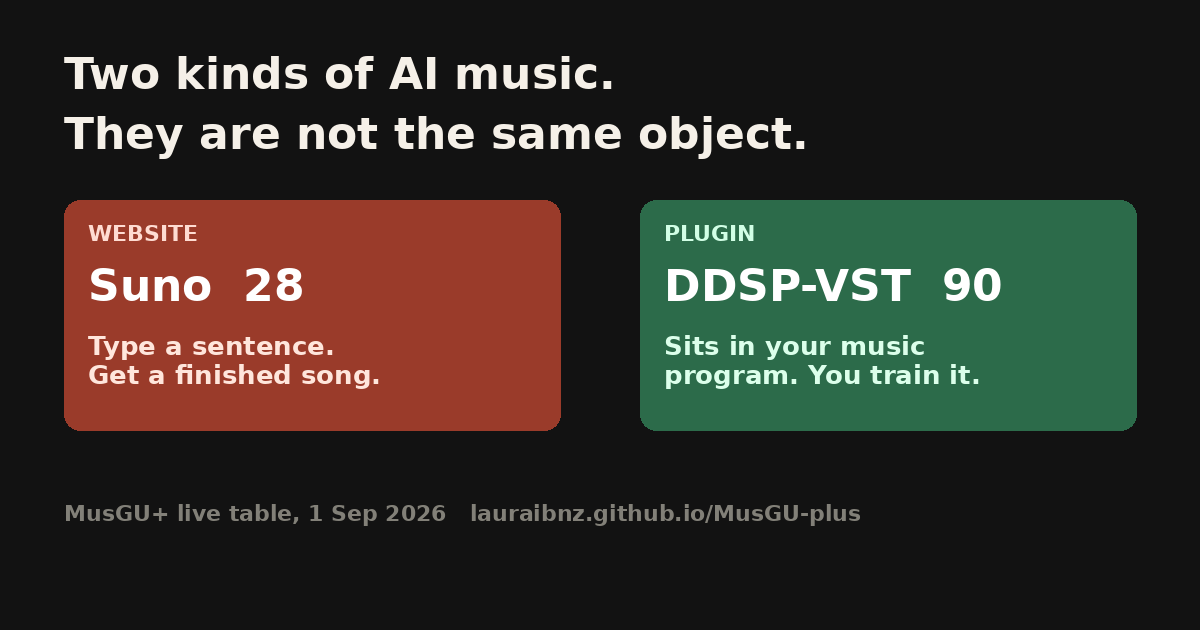
Suno scored 28. That number needs a footnote.

1 September 2026

Suno scored 28 out of 100. A public scorecard of AI music tools put it near the bottom, while a Google plugin sits near the top. If you have used paid Suno, that ranking can look wrong. You can upload a vocal. You can point the system at your own projects. It does learn something from you. This piece explains who wrote the scores, what the words mean, and where the table and the product disagree.

Who made the score

MusGU+ is not a magazine poll and not Suno’s marketing. It is an academic evaluation grid plus a website, aimed at AIMC 2026, the AI Music Creativity conference in Berlin, 16–18 September.[1][2][4]

The paper on GitHub still says “anonymous authors” because it is under review.[2] The repository is not anonymous. The main commits come from Laura Ibáñez-Martínez, a PhD student at the Music Technology Group, Universitat Pompeu Fabra, in Barcelona.[2][9] Roser Batlle-Roca, also at UPF, built the earlier MusGO grid (openness of music models) and contributed here.[2][10] Błażej Kotowski shows up in the commit log; he also works on PLAUD, one of the tools in the table.[2][11]

So: university researchers in music technology, not a start-up leaderboard. They published the criteria, a YAML file per tool, and a filterable table. Anyone can open an issue and argue a score.[2]

That last point matters. If Suno’s paid features should move the adaptability number, the honest place to fight is that YAML, not a vibe.

What they are scoring

MusGU+ stands for Music-Generative Usable+ AI. Three questions, each broken into smaller checks that can only be yes, partly, or no.[3]

Adaptability. Can I realistically adapt this model to my own data? Their examples are training code, checkpoints, LoRA, a Colab that fine-tunes weights, a plugin you train on a short recording and then keep. They also ask whether you can take that adapted model with you (redistribution).[3][7]

Usability. Can I run it, pay for it, put it in a DAW, export stems, get help when it breaks.[3]

Controllability. Can I steer the music on purpose: MIDI, lyrics, audio input, pitch, time, not only a text prompt.[3]

Overall is the average of those three. Fourteen tools on 1 September 2026. Mean 59.5.[1]

Two products, same marketing word

People say “AI music” for both of these.

Suno (and Udio) is a website and an app. You type a description or lyrics. Their computers in the cloud write a finished song. On Pro and Premier you also get Suno Studio, upload audio (up to 30 minutes), Voices, add vocals, and a line on the pricing page called Custom Models.[8] You do not install a music engine on your PC. You rent access.

A VST (AU on a Mac) is a small program that plugs into the mixing software already on your machine: Ableton, Logic, Reaper, Cubase. Think of a guitar pedal, except digital. DDSP-VST, from Google Magenta, is that kind of object. Magenta’s notes, quoted in MusGU+, say you can train a usable instrument on about 10 to 20 minutes of monophonic audio, then play it in real time inside the DAW.[1][3]

If you only know Suno, “plugin scored 90” sounds like snobbery. If you only know VSTs, “Suno scored 28” sounds like the researchers never opened the paid plan. Both reactions are fair until you read what “adapt” means in their spreadsheet.

The table

Live numbers, 1 September 2026.[1]

What you are looking at Name Overall Adapt. Use Control
Plugin in a DAW DDSP-VST (Google Magenta) 90 70 100 100
Musician-facing app / plugin Neutone Morpho 82 80 92 75
Research software you can run RAVE (IRCAM) 79 70 92 75
Research software AFTER (IRCAM) 78 50 83 100
Research tool, Barcelona SCAPES (UPF) 77 90 67 75
Research tool, Barcelona PLAUD (UPF) 76 70 83 75
Easy to start, hard to retrain Magenta RealTime 2 65 20 100 75
Company audio model Stable Audio 3 58 60 75 38
University song model YuE 49 40 58 50
Lab model JAM 44 40 42 50
Downloadable Meta model MusicGen 43 30 50 50
Smaller Stability model Stable Audio Open Small 43 40 50 38
Website / app Suno 28 0 58 25
Website / app Udio 21 0 50 12

The Suno problem

Suno’s adaptability is 0 in MusGU+. The researchers wrote, in the Suno file, that no training or fine-tuning path is exposed: no code, no checkpoints, no interface that produces a model you can keep. Weights stay on Suno’s servers. Redistribution is not allowed under the terms.[6][7]

That is a specific claim. It is not “Suno never hears the user.”

On the pricing page, Pro and Premier list Upload Audio (30 minutes), Voices, Add vocals, Custom Models, and Suno Studio.[8] The same MusGU+ file already admits audio-guided generation, lyrics, tags, continuation, editing, and remixing. They filed that under controllability, not adaptability, and still only gave it a partial.[7]

So if you pay, upload a vocal, and hear the next song come back in something like your voice, you are not imagining it. The product is built to condition on your audio. A musician would call that learning from the user. MusGU+ would call it a prompt with a sound file attached. They reserve “adapt” for: I change the model, I can run the result without their website, I could share the adapted weights.

Those are different jobs. The 0 is honest inside their definition and misleading if you read “adapt” as “the app gets to know my projects.” The article should have said that in the first version. It did not.

If the paid Custom Models path is real fine-tuning of a private model (still hosted), MusGU+ might still score redistribution as no, and hardware/dataset as “cannot say,” but “no adaptation pathways” would be too blunt. That is a fair challenge to send to their GitHub issues.[2][8]

What still stands

The table is useful once you know the rule. Tools you can train on a short personal recording and then play inside a DAW sit at the top. Tools that only exist as a cloud jukebox sit at the bottom, even if the jukebox is good, even if it accepts your vocal.

Usability is the column where Suno is not a joke: 58, with a full mark for the web and phone apps.[6] People use it because it is easy. The researchers did not deny that. They asked a different question.

MusGO, Batlle-Roca’s earlier project, scores how open the science is. MusGU+ scores whether a musician can adopt the thing on their own terms.[2][5] AIMC 2026 will spend three days in Berlin on “spawned” music and who owns the interface.[4] This spreadsheet is the unglamorous version of that argument.

Live table: https://lauraibnz.github.io/MusGU-plus/

Suno’s own score sheet: https://lauraibnz.github.io/MusGU-plus/models/suno/

Sources

  1. https://lauraibnz.github.io/MusGU-plus/ (table scraped 1 Sep 2026)
  2. https://github.com/lauraibnz/MusGU-plus
  3. https://lauraibnz.github.io/MusGU-plus/framework.html
  4. https://aimc2026.org/home
  5. https://roserbatlleroca.github.io/MusGO_framework/
  6. https://lauraibnz.github.io/MusGU-plus/models/suno/
  7. https://raw.githubusercontent.com/lauraibnz/MusGU-plus/main/projects/suno.yaml
  8. https://suno.com/pricing
  9. https://github.com/lauraibnz
  10. https://github.com/roserbatlleroca
  11. https://github.com/blazejkotowski

Why I’m Leaving Spotify (and Why Deezer Looks Fairer)

Silhouette of an executive facing military drones over a Europe map with circuit lines, symbolizing defense-AI ties.

Leaving Spotify wasn’t a snap decision — here’s the deep dive that led to it: sources, payouts, and the CEO’s defense-tech investments.

A deep dive with sources, payouts, and the CEO’s defense-tech investments

TL;DR

  • Spotify’s CEO Daniel Ek—via his investment firm Prima Materia and as Chairman of Helsingled a €600 million round into a European defense/AI company that builds drones and other military systems. Multiple artists left Spotify in protest. (Helsing, Financial Times, Reuters)
  • Deezer is rolling out AI-content detection/tagging and excludes fully AI-generated tracks from algorithmic/editorial recommendations; it also partners on an artist-centric payout model intended to reward real artists more fairly. (Music Business Worldwide, Deezer Newsroom, UMG, PR Newswire)
  • On payouts, there’s no single “true” per-stream rate—but credible snapshots across the last decade show Spotify hovering ~$0.003–$0.005 per stream (to rights-holders), while Apple Music and Tidal are typically higher. Details below. (RouteNote, Music Ally, Pitchfork, Royalty Exchange)

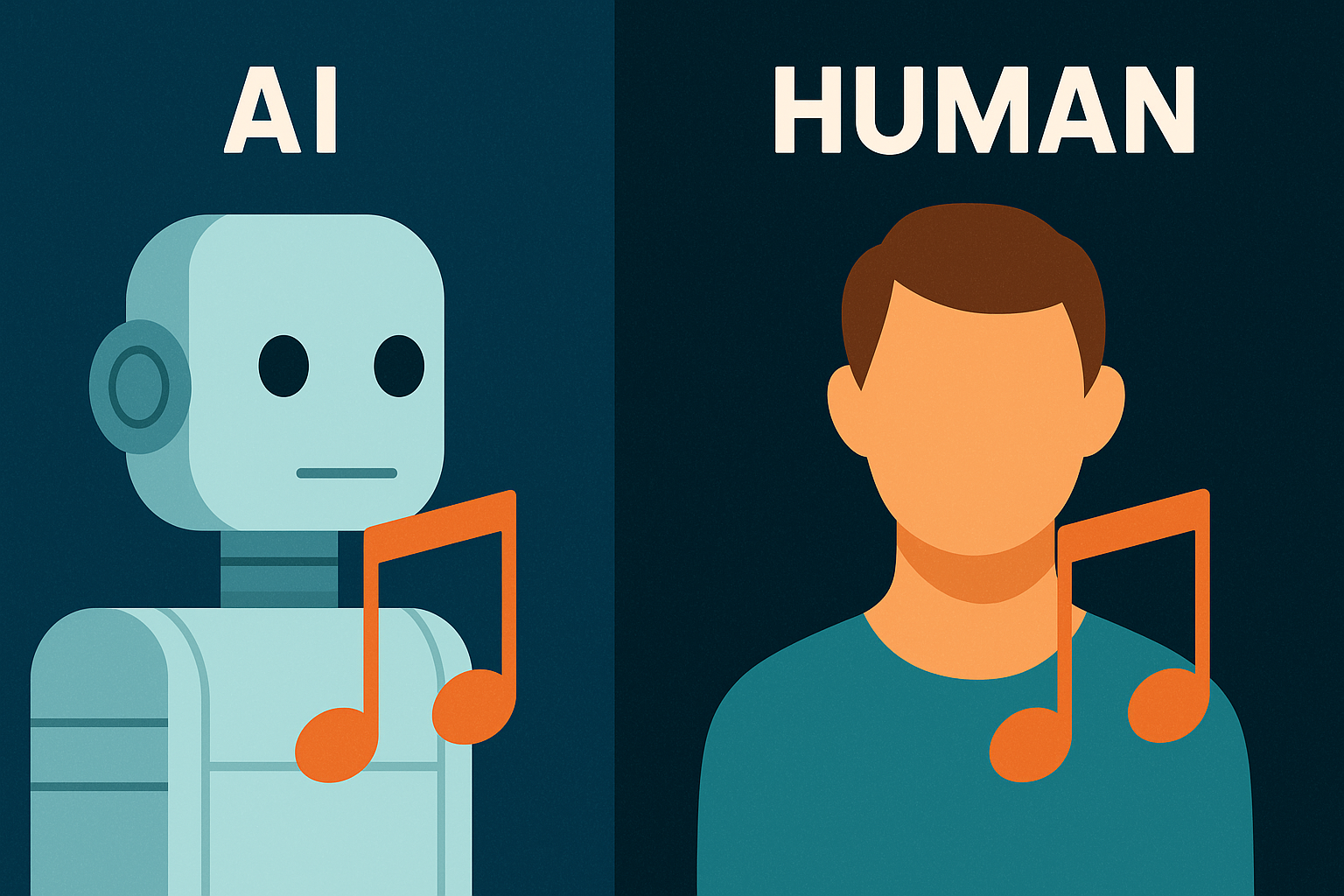
Split screen: AI robot singer vs. human singer with an AI-filter icon indicating blocked synthetic tracks.
agging and excluding fully AI-generated songs to protect real artists and playlists.

1) The Defense-Tech Investment At The Top

In June 2025, Helsing announced a €600 million Series D funding round led by Prima Materia (Daniel Ek’s firm). The press release also states Ek is Chairman of Helsing. Major outlets (FT/Reuters) corroborated the amount, context, and that Helsing now builds AI-enabled drones, aircraft, and subsea systems. (Helsing, Financial Times, Reuters)

The announcement intensified criticism from artists who argue that music subscription money—while not directly invested by Spotify—ultimately enriches a leadership circle backing military AI. Several prominent acts have removed or begun removing their catalogs from Spotify on ethical grounds (Deerhoof, Xiu Xiu, King Gizzard & the Lizard Wizard; more in Canada and elsewhere). (Music Ally, The Fader, Pitchfork, Consequence, Billboard Canada)


2) The AI-Music Problem—and Why Deezer’s Response Matters

AI-generated uploads exploded in the last 18 months. Deezer reported that ~18% of all tracks uploaded were fully AI-generated (20k+ per day). In response, Deezer launched AI-detection, tagging, and exclusion of fully AI-generated content from recommendations to reduce fraud and protect artist remuneration. Associated Press and Music Business Worldwide covered the rollout and rationale. (Reuters, Deezer Newsroom, Music Business Worldwide, AP News)

In 2023, Universal Music Group + Deezer announced an artist-centric streaming model, shifting payouts toward professional artists (and away from “noise” content). Academic/industry analyses have followed its implications. (UMG, PR Newswire, Deezer Newsroom, Music Business Research)


3) What Streaming Really Pays: A 10-Year View (Context, Not Gospel)

Important caveat: Platforms pay rights-holders (labels/distributors, publishers/PROs), not artists directly. Rates vary by country, subscription tier, deals, market share, and time—so real-world payouts fluctuate. Spotify itself emphasizes there is no fixed “per-stream” rate and publishes “Loud & Clear” with totals and earning tiers instead. In 2024, Spotify says it paid $10 billion in royalties (≈ two-thirds of revenue). Independent journalism has questioned how that aggregates down to most artists. (Loud and Clear, Spotify, Financial Times, Marktbeobachtung)

Selected benchmarks (Spotify, rights-holder averages)

YearEst. avg. per streamSource / Notes
2014$0.00521Trichordist “Streaming Price Bible” (indie label dataset). (The Trichordist)
2016$0.00437Trichordist update (drop vs 2014). (The Trichordist)
2018$0.00331Trichordist 2018 report. (The Trichordist)
2019$0.00348Trichordist 2019; covered by Music Ally. (Music Ally)
2021~$0.003–$0.005Range cited widely (e.g., Business Insider via MUO). (MakeUseOf)
2025~$0.003–$0.005Current aggregate range (RouteNote explainer). (RouteNote)

How that compares to others (recent snapshots)

Method note: The Trichordist’s numbers come from a mid-sized indie label’s actual statements (millions/billions of streams), giving a useful—but not universal—view. Differences across catalogs, territories, free vs. premium tiers, and contracts can shift your personal effective rate up or down. (The Trichordist)


4) Practicalities: Moving From Spotify to Deezer

Deezer’s built-inTransfer your favorites” (mobile Settings or web Account Settings) integrates TuneMyMusic directly—no separate signup needed—to import liked tracks, playlists, and followed artists from Spotify. Deezer announced this in 2021 and continues to support it; community reports confirm it’s smooth for large libraries. (Limits historically noted: up to 2,000 playlists and 10,000 favorite tracks per run.) (Deezer Newsroom, RouteNote)


Minimal “AI vs HUMAN” comparison with music notes, highlighting synthetic vs. human-made music.
A reminder to favor human creativity and fair-pay models in streaming.

5) So… Why I’m Switching

  • Governance / Ethics: I don’t want my subscription tied to leadership actively backing AI warfare tech. Daniel Ek—via Prima Materia and as Chairman of Helsing—led a €600m round into a defense-AI company. That’s a misalignment with the culture I want to support.
  • AI Noise & Fraud: Deezer detects/tags fully AI-generated tracks and excludes them from editorial/algorithmic recommendations, which better protects real artists and my listening experience. (Spotify)
  • Fairer Tilt: Deezer and UMG’s artist-centric experiments try to direct more money toward legitimate, engaged listening rather than “noise.” That’s closer to what I want to fund. (Spotify)
  • Sound Quality: Deezer’s FLAC (16-bit/44.1 kHz) tier outclasses Spotify’s current 320 kbps Ogg for music streaming.
  • Price hikes & plan complexity (Germany): Spotify just raised Premium Family to €21.99/month (from €17.99), Duo to €17.99, and Individual to €12.99—effective for new subscribers from Aug 14, 2025, rolling to existing users afterward. Spotify’s Premium now also bundles 12 hours/month of audiobooks, while a “Basic” option (old pricing) exists without audiobooks—but only for selected existing customers. Meanwhile, podcasts can still include creator-inserted ads even on Premium, which makes the value prop uneven if you’re heavy on podcasts. (heise online, Spotify, Spotify Community)

6) What This Data Can—and Can’t—Tell You

  • Per-stream ≠ artist take-home. Labels, distributors, and publishers split the pie before it reaches the artist. Two artists with identical stream counts can earn differently. (SAGE Journals)
  • Rates float. Geography, subscriber share, free vs. paid, and catalog deals drive variance; treat ranges as directional, not absolute. (Loud and Clear)
  • Totals have grown. Spotify’s annual royalty pool reached $10 billion in 2024, but distribution remains contentious and skewed—hence the push for new models. (Financial Times, Marktbeobachtung)

7) Sources / Linknotes


AI to generate music – stuff i want to try out

AI to generate music is worth exploring — here’s a hands-on list of tools songwriters can actually try.

Artificial intelligence (AI) has the potential to revolutionize the way songwriters create and produce music. With AI tools, songwriters can generate new melodies, harmonies, and lyrics, or even write entire songs based on a set of input parameters. Here are the top 10 best AI tools for songwriters:

  1. Jukedeck: Similar to Amper, Jukedeck is an AI music composer that can generate original compositions based on input parameters. Jukedeck offers a range of customization options, including the ability to specify the style, mood, and length of the piece.
  2. AIVA (Artificial Intelligence Virtual Artist): AIVA is an AI composer that can create original music in a variety of styles, including classical, rock, and electronic. In addition to generating original compositions, AIVA can also provide feedback and suggestions for improving existing pieces of music.
  3. Amper Music: Amper is an AI music composer that can create original music in a variety of genres. Simply enter your desired mood, length, and style, and Amper will generate a unique piece of music in seconds. The platform also offers a range of customization options, including the ability to specify instrumentation and tempo.
  4. Melodrive: Melodrive is an AI music composition tool that uses machine learning to generate original melodies in a variety of styles. The platform offers a range of customization options, including the ability to specify the length, tempo, and instrumentation of the piece.
  5. Autochords: Autochords is an AI music composition tool that can generate chord progressions based on input parameters. The platform offers a range of customization options, including the ability to specify the style, key, and tempo of the piece.
  6. Popgun: Popgun is an AI music composition tool that uses machine learning to generate original melodies and chord progressions. The platform offers a range of customization options, including the ability to specify the style, tempo, and instrumentation of the piece.
  7. OpenAI MuseNet: MuseNet is an AI music composition tool developed by OpenAI that can generate original music in a variety of styles and genres. The platform uses a neural network trained on a large dataset of music to generate unique compositions.
  8. LyricAI: LyricAI is an AI tool that can help songwriters generate new lyrics for their songs. Simply enter a few details about the song you’re working on, and LyricAI will generate a list of potential lyrics based on your input.
  9. Songsmith: Songsmith is an AI music composition tool developed by Microsoft that can generate original melodies and chord progressions based on input parameters. The platform offers a range of customization options, including the ability to specify the style, tempo, and instrumentation of the piece.
  10. Jukebox: Jukebox is an AI music composition tool developed by OpenAI that can generate original music in a variety of styles and genres. The platform uses a neural network trained on a large dataset of music to generate unique compositions.

In conclusion, AI tools offer a range of benefits to songwriters, including the ability to generate original melodies, harmonies, and lyrics, or even write entire songs based on input parameters. These tools can help songwriters save time and effort, and inspire new creative ideas.